
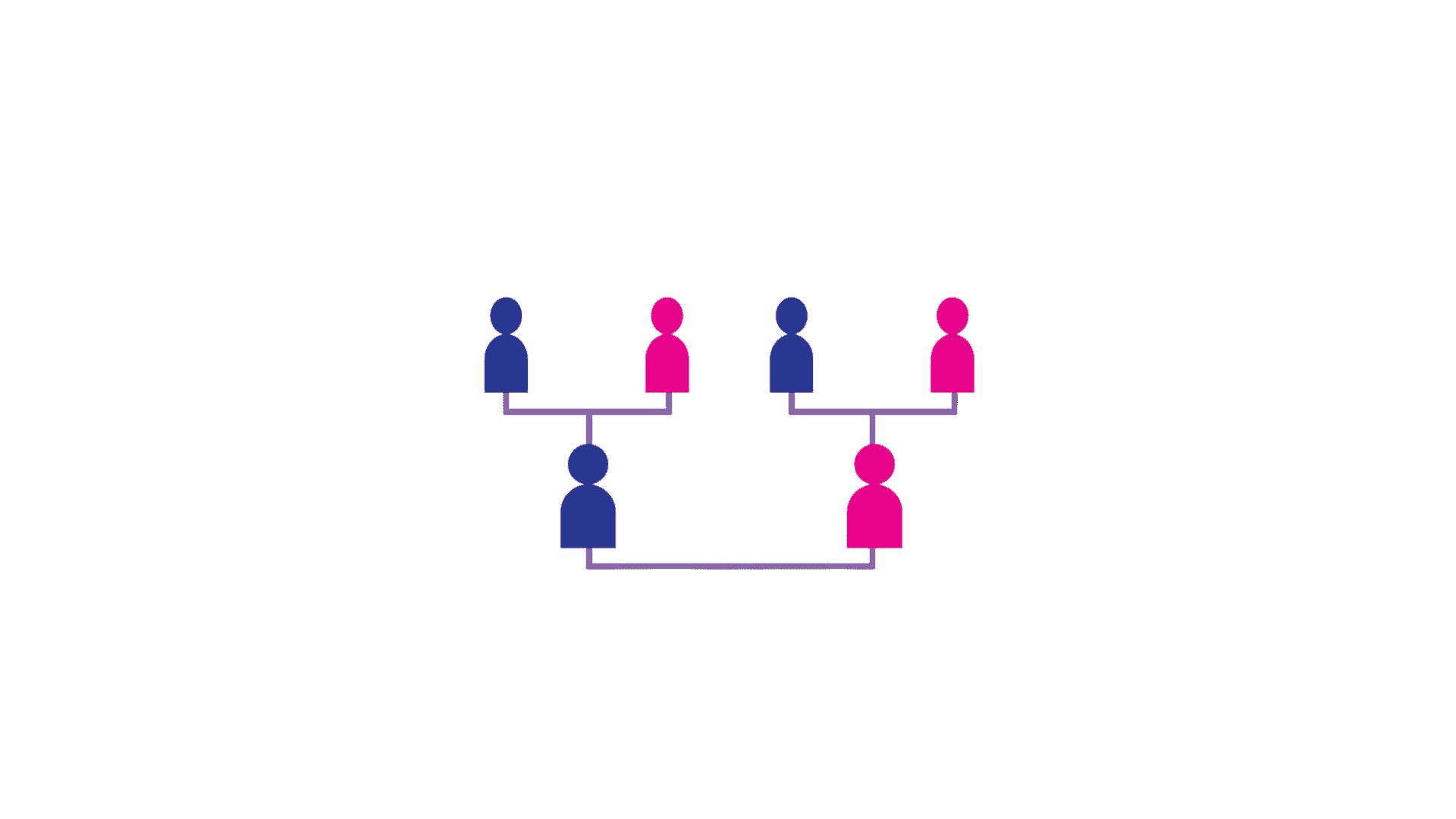
When we are uncomfortable with another, we often avoid dealing directly with that relationship by triangling a third person or issue. Understanding how triangles work and how to deal with them is essential to healthy functioning.
This is the audio of Chapter 4 on Triangles from my book, If You Met My Family, You’d Understand: A Family Systems Primer. You can find all 10 chapters of the book in Episodes 56-65 of this Podcast.
Show Notes:
If You Met My Family, You’d Understand: A Family Systems Primer
What IS a Failure of Nerve? – The Non-Anxious Leader
The Differentiated Leader – The Non-Anxious Leader
Check out The Non-Anxious Life, a FREE AI Family Systems Coach.
Become a Patron for as little as $5/month.
Subscribe to my weekly Two for Tuesday email newsletter.
[00:00:34.300]
Welcome to Episode 396 of The Non-Anxious Leader podcast. I'm Jack Shitama. Before we get into today's episode, I want to remind you that we have two upcoming learning opportunities. The first is What Is a Failure of Nerve? It is a 4-week book study based on Edwin Friedman's seminal work. If you want to get into what leadership Through Self-Differentiation, looks like this study is for you. It is Tuesdays from September 8th to the 29th. That's 4 Tuesdays, each at 5:00 PM for an hour and a half till 6:30 PM Eastern Daylight Time. The cost is $99. I'll put a link in the show notes for more information and to register. The second opportunity is the Differentiated Leader of Family Systems Theory Community of Practice. This is an 8-month deep dive into Bowen Family Systems Theory. We will meet once a month on the second Monday of each month from 7 to 8:30 PM Eastern time, beginning on October 12th. The cost is free. There is no charge to join this community of practice, and you don't even have to make every session. If you want to deepen your understanding of family systems theory and learn how to apply it to your life, then this is a community of practice for you.
[00:01:55.250]
I will put a link in the show notes to find out more information and to sign up. And if you're new to this podcast, you can connect with me at jack@christian-leaders.com with your questions, comments, and suggestions for future episodes. And you can get more resources at thenonanxiousleader.com where you can find out about my coaching practice, speaking engagements, books that I've written, and courses that I offer. You can also subscribe to my Two for Tuesday email newsletter and get your free AI family systems coach at the website or at the links in the show notes. Finally, if you would like to support my work for as little as $5 a month, you can get more information and sign up at the link in the show notes. Thanks in advance for your consideration. And now a caveat. I know in the last episode I promised that I would get into how to rework your primary triangle in this next episode, but I had an a speaking engagement that involved several days of travel this past week, then had family visits this weekend. I thought I would be able to get the episode completed before the time it normally drops, but that just did not happen.
[00:03:06.510]
So I'm doing a rebroadcast on triangles so that you might refresh your memory, dig a little deeper between the episode on your primary triangle and on how to rework it. So now, without further ado, here is episode 396, a rebroadcast of Triangles: What They Are, How They Work, and How to Manage Them. Today's episode is a rebroadcast of episode 59, which is chapter 4 of my book, If You Met My Family, You'd Understand: A Family Systems Primer, and the chapter title is Triangles.
[00:03:49.620]
If you don't understand triangles, you will have a difficult time being a non-anxious presence. You will have a difficult time growing as a self-differentiated leader.
[00:04:01.370]
So let's get started.
[00:04:03.520]
You can change yourself and you can change the situation, but you absolutely cannot change other people. Only they can do that. Joanna Trollope. A triangle occurs when two people become uncomfortable in their relationship and they focus on another person or issue to stabilize it. For example, when two spouses are uncomfortable in their relationship, they might focus on the work of one of the spouses as the third side of the triangle. One spouse may work long hours while the other spouse complains about it. By focusing on the work, they avoid having to deal with their own relationship. This also highlights the example that a triangle does not have to include 3 people. It can be any combination of persons and issues. If all change is loss and somebody finds a replacement for that loss before they have a chance to grieve, that is a triangle between the person, what is lost, and the replacement. The most stable form of relationship. Murray Bowen, the pioneer of family systems theory, believed the triangle to be the most stable form of human relationship. This is because a two-person relationship is inherently unstable.
[00:05:24.790]
Why?
[00:05:25.980]
Because the best we can hope for is to be self-differentiated 70% of the time, and most of us function that way less than 50% of the time. When people are not functioning in self-differentiated ways, they are less willing to take responsibility for themselves. They are unable to tolerate tension in their relationship before resorting to triangling a third person or issue for stability. This ultimately leads to triangles. There is a paradox in triangles: they are more stable than a two-person relationship, but they can create an odd person out. People don't like being excluded. The anxiety generated by this kind of exclusion makes triangles both explosive and difficult to break. In the example given, the odd person out is the spouse who feels excluded by the other's investment in her work. This creates tension and can ultimately lead to conflict. It can also lead to emotional withdrawal. Each of these is a response to being excluded via emotional triangle. If a triangle is used to stabilize an uncomfortable relationship, there are several ways this can occur. One is when a person feels like they need more attention or approval from the other and reacts automatically in immature ways.
[00:06:49.660]
In this example, the spouse who feels excluded erupts in anger every time the other comes home late from work. Instead of self-differentiating and saying how he would like to spend more time with his wife, he focuses on his wife's job. Another is when someone has unrealistic expectations of herself or another. In our example, the wife might be using her work to bolster her own self-image. Instead of being comfortable in her own skin, that is, being self-differentiated, she uses the external motivation of succeeding in her work to justify herself. Conversely, she might have unrealistic expectations of her husband, but can't express herself, so she buries herself in her work. People are a mess, and we use endless ways to avoid dealing with our own issues. Nobody gets the problem they can handle. Another is difficulty in maintaining appropriate boundaries. When one is feeling stress or tension, she might distance herself from the other or become overly intrusive with the other. In our example, the wife could have initially used her job to distance from her husband. Or, the husband might have allowed his own anxiety to spill into their relationship the first time she came home late from work.
[00:08:10.770]
Either of these could have occurred first. Both could be occurring to maintain the triangle. She comes home late, he reacts, she distances herself even more to avoid dealing with him. Did I mention the people are a mess? Either of these responses is subconsciously intended to relieve anxiety, but instead they increase the discomfort in the relationship, which can result in forming, then maintaining, a triangle. Here are some other examples of triangles. One example is two spouses and a child. To avoid self-differentiating with each other, one of the parents, typically the mother, fulfills the unmet emotional needs from her spouse by investing in her child. This leaves the husband on the outside, who usually be supportive of the over-involvement. In this case, the mother's over-functioning with the child is complemented by the father's under-functioning. Another form of parent-child triangle occurs when both parents focus all their efforts on developing a skill or talent in a child. This could be dance, music, sports, or academics. Fill in the blank. It's process, not content, which I'll unpack in the next chapter. It is their focus on their child that stabilizes their relationship with each other. A second example is a parent and two children.
[00:09:36.590]
The parent is not comfortable with self-differentiating with either of the children, so she calls one whenever she has a problem with the other. "Tell your brother that I don't like how he is handling the family business," or "Did you know your sister is letting her son do whatever he wants?" or "I'm really angry that your brother is choosing to go to his wife's house for Christmas instead of being with us." You get the picture. Again, the content can be anything. It's process, not content, and the process is the inability to deal with one's own anxiety in a self-differentiated way, resulting in an emotional triangle. You can't change the relationship of others. A guiding principle of emotional triangles is that you can't change a relationship to which you don't belong. You probably have learned by now that you can't change other people. This applies to triangles. In the first example where the husband is complaining about the amount of time his wife spends working, the complaints will likely not change the situation. In fact, the more time he spends trying to convince her to work less, the more likely it will be that she doesn't. This is an example of another principle of emotional triangles: when you try to change the relationship of the other two sides of a triangle, it not only strengthens the triangle, but you also will end up with the stress of the situation.
[00:11:07.170]
The husband will be the one who is feeling left out. The wife will be fine because she has her work to distract her. Paradoxically, if he got out of the triangle in between his wife and her work, he might have a chance. We'll cover that in more depth in the next chapter. So it won't be the wife who works too much that feels the stress. It will be the husband who complains. This will likely result in a workaholic wife and a husband who dysfunctions in some other way. Which leads to the final principle of triangles, which is that triangles interlock. When the complaining spouse gets tired of complaining about his wife's work, he will find something else to do to stabilize that relationship. Perhaps he will focus on complaining about his pastor, or maybe he will turn to drinking. The least likely thing he will do is to take responsibility for himself. This final point is our first clue in understanding how to deal with triangles. Dealing with triangles. The best way to avoid a triangle is to take responsibility for yourself and nobody else. This is the essence of self-differentiation. But remember, self-differentiation includes both self-definition, which is taking responsibility for oneself, and emotional connection, which is the presence part of being a non-anxious presence.
[00:12:37.200]
When someone is triangling you, a helpful way to look at it is to think, "She is uncomfortable with this other relationship, so she is triangling me." By doing this, you can avoid taking it personally and avoid trying to fix the situation. Either action would draw you into the triangle. The second thing you can do is to give her back responsibility for her problem. Instead of taking on her anxiety, You can give it back. Let's say that a coworker comes to you and complains about another coworker. Alarms should be going off in your head. She is defining your coworker, not defining herself. She is not acting in self-differentiated ways. She is not comfortable with her relationship with your coworker, so she is coming to you. Here are some things you could say to give the problem back to her: Sounds like you really have a problem. You're really struggling with this. Have you told her how you feel? The best thing you can do is not argue and not agree. If you argue with her, you are basically trying to convince her that she's wrong about the other. If you agree with her, you've been brought into the triangle as an accomplice.
[00:13:53.890]
I'll go into this further in Chapter 7. I recently had a colleague text me to say he had received a snarky email from someone he served with on a committee. He wrote, "I realized that she was defining me, not herself." What he understood was that when someone is defining you, she is avoiding something in herself. Recognizing this process is essential to avoiding triangles and responding to them in a healthy way. That's the focus of the next chapter. Questions for reflection: How do you handle an uncomfortable relationship? Are you able to take responsibility for yourself, or do you triangle someone or something else? How are others triangling you? What can you do to stay connected to those who triangle you without trying to change them.
[00:14:52.320]
That's it for episode 396. I will be back next week with that episode on how to rework your primary triangle. And remember, you can connect with me at jack@christian-leaders.com, and you can find more resources at thenonanxiousleader.com. And if you found this episode helpful, please share it with someone who would benefit, and please leave a review on your podcast platform of choice. Thanks in advance for your help. Until next time, go be yourself.