
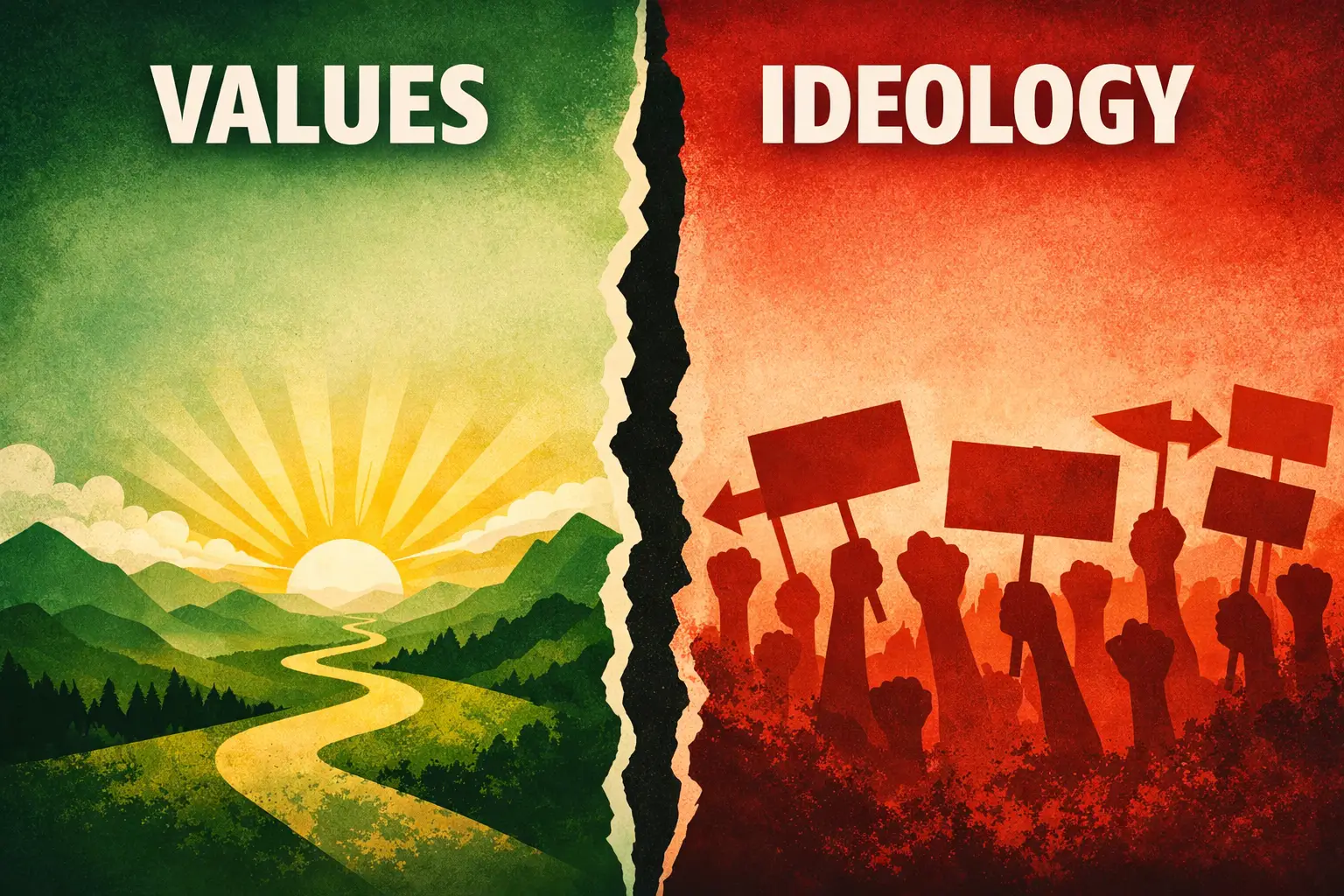
If you want to lead through self-differentiation, you need to understand the difference between values and ideology. This episode covers that and what to do with it.
Show Notes:
The Best Decision-Makers Are Value-Driven But Not Ideologically Committed – Admired Leadership
Check out The Non-Anxious Life, a FREE AI Family Systems Coach.
Become a Patron for as little as $5/month.
Subscribe to my weekly Two for Tuesday email newsletter.
[00:00:34.240]
Welcome to episode 383 of The Non-Anxious Leader Podcast. I'm Jack Shitama. If you are new to this podcast, you can connect with me at jack@christian-leaders.com with your questions, comments, and suggestions for future episodes. And you can get more resources at thenonanxiousleader.com, where you can find out about my coaching practice, speaking engagements, books that I've written, and courses that I offer. You can also subscribe to my Two for Tuesday email newsletter and get your free AI Family Systems Coach at the website or at the links in the show notes. Finally, if you would like to support my work for as little as $5 a month, you can get more information and sign up at the link in the show notes. Thanks in advance for your consideration. And now, without further ado, here is Episode 383: Values, Ideology, and Leadership Through Self-Differentiation. Edwin Friedman defined self-differentiation as the ability to claim your goals and values in the midst of surrounding togetherness pressure. Further, leadership through self-differentiation is the ability to do this and stay emotionally connected to the most anxious and resistant. The idea for this episode comes from an article in the Admired Leadership Substack, "The Best Decision Makers Are Value-Driven But Not Ideologically Committed." I'll put a link to this in the show notes.
[00:02:11.840]
It makes a critical distinction between values and ideology. Values and ideology get confused all the time. They sound similar, and in anxious systems, they often get fused together, but they function very differently. And if you're trying to lead with clarity, especially under pressure, this difference matters. Values are the principles you're willing to be responsible for. They're the commitments you're willing to live out whether or not anyone else agrees with you. Values are internal and drive how we function in the world. Ideology is a belief system that provides a fixed set of positions that tells you what to think, how to interpret events, and which side you're supposed to be on. While values are internal, ideology is external. In Family Systems terms, values are a function of differentiation. Ideology is a function of surrounding togetherness pressure. Ideology provides the norms and values that one must believe to be a part of that belief system. A differentiated person can say, "This is what I believe, and this is how I'm going to show up," without needing others to match them. An anxious person needs alignment. They need agreement. They need the relationship system to validate their position.
[00:03:34.070]
And when they don't get it, they get reactive or adaptive. This is why ideology spreads so quickly in anxious families, congregations, and organizations. It gives people a ready-made stance. It reduces uncertainty, and it tells them who the good guys and the bad guys are. It creates the illusion of strength while actually increasing reactivity. Values work differently. Values require self-regulation. They require reflection and the ability to tolerate discomfort. Values don't tell you what to think. They tell you how to be. The Admired Leadership article makes this point in a different way. The best decision-makers aren't the ones who cling to a rigid framework. They're the ones who stay grounded in a set of core values and use those values to navigate complexity. They don't need a script. They process the world through the lens of their values. This requires reflection, self-awareness, and intentionality. In Family Systems terms, that's the difference between leading from self, that is, leadership through self-differentiation, and leading from anxiety. When you lead from self, you're guided by your principles. You're able to think and stay connected without being consumed. You're able to make decisions that reflect who you are, not who the system wants you to be.
[00:04:58.020]
When you lead from anxiety, you're guided by the emotional field. You're scanning for threat. You're trying to manage other people's reactions. You're trying to avoid conflict or force consensus. That's ideology at work because ideology has a bias towards emotional safety, not clarity. The article also makes one important point. It describes ideology as a fixed belief system. It goes further to say that a good leader can hold a fixed belief system in their personal lives without abandoning it when coming to work. In this case, the ideology informs their values, which can be an anchor without forcing their beliefs on others. If you are a Christian in a secular workplace, this is a key concept. But the article goes further to say that great leaders are open-minded and curious without letting their ideology influence their thinking. This is a skill that's needed now more than ever. Here's the key: values create flexibility, ideology creates rigidity. Values help you think, ideology feeds reactivity. Values strengthen integrity, ideology forces polarization. And in anxious systems, polarization is a sign that ideology might be taking over. So how do you lead as a non-anxious presence in a system that's drifting towards ideology?
[00:06:30.210]
We'll cover that next. The way to deal with ideology in an anxious system is to start by clarifying your own values, not values that you've inherited or that you think you're supposed to have, but the values you're actually willing to live by. It's only a value if you're willing to take responsibility for it. Once you're clear on that, you practice holding those values without demanding that others share them. That's the heart of self-differentiation. You can be yourself while staying connected to others. It's the ability to be a self while allowing others to do the same. This means you stop trying to convert people. Ideology needs converts. Values don't. Values simply need to be lived. And you pay attention to your reactivity. Ideology thrives on emotional intensity. It feeds on urgency, outrage, and certainty. When you feel yourself getting swept up in that energy, it's a signal to slow down, breathe, and return to your principles. So here are a few practical steps to help you lead through self-differentiation. First, name your top 2 or 3 values in behavioral terms. For example, instead of saying, "Integrity," say, "I tell the truth, even when it's uncomfortable." Or, instead of thinking "respect," think, "I speak to people in a way that reflects their dignity." Values are verbs, not slogans.
[00:08:02.950]
Second, practice stating your position calmly and briefly. A self-differentiated stance doesn't require a speech; it requires clarity and brevity. Some examples: I'm not comfortable with that direction. I'm going to take a different approach. This is the decision I'm making. These responses are short, steady, and self-differentiated. Third, stay connected without over-functioning. You don't have to fix the system. You don't have to manage everyone's reactions. You don't have to convince anyone. You simply have to remain present and responsible for yourself. Fourth, watch for surrounding togetherness pressure. When people start to say things like, "Are you with us or not?" or "Everyone agrees this is the only way" or "This is what people like us believe," you know that's ideology talking. It's herding. It's the system trying to pull you into its anxiety. And when you hear that tone, when you hear those words, you don't need to fight it. You just need to stay grounded in your values. Values. Finally, remember that leadership through self-differentiation is slow, steady work. It doesn't create dramatic moments; it creates durable ones. It doesn't win arguments; it builds trust. It doesn't eliminate anxiety; it lowers the temperature so people can think clearly.
[00:09:31.300]
The best decision-makers aren't the loudest or the most certain. They're the ones who can hold their values with integrity while staying connected to the people around them. That's what helps people to view them as steady and trustworthy, and that's what makes them effective in anxious systems. When you lead from your values instead of ideology, you give the system something it desperately needs: a calm, clear, non-anxious presence. And it's that presence that helps others to do their best work. That's it for episode 383. Remember, you can connect with me at jack@christian-leaders.com, and you can find more resources at thenonanxiousleader.com. And if you found this episode helpful, please share it with someone who would benefit, and please leave a review on your podcast platform of choice. Thanks in advance for your help. Until next time. Go be yourself.