
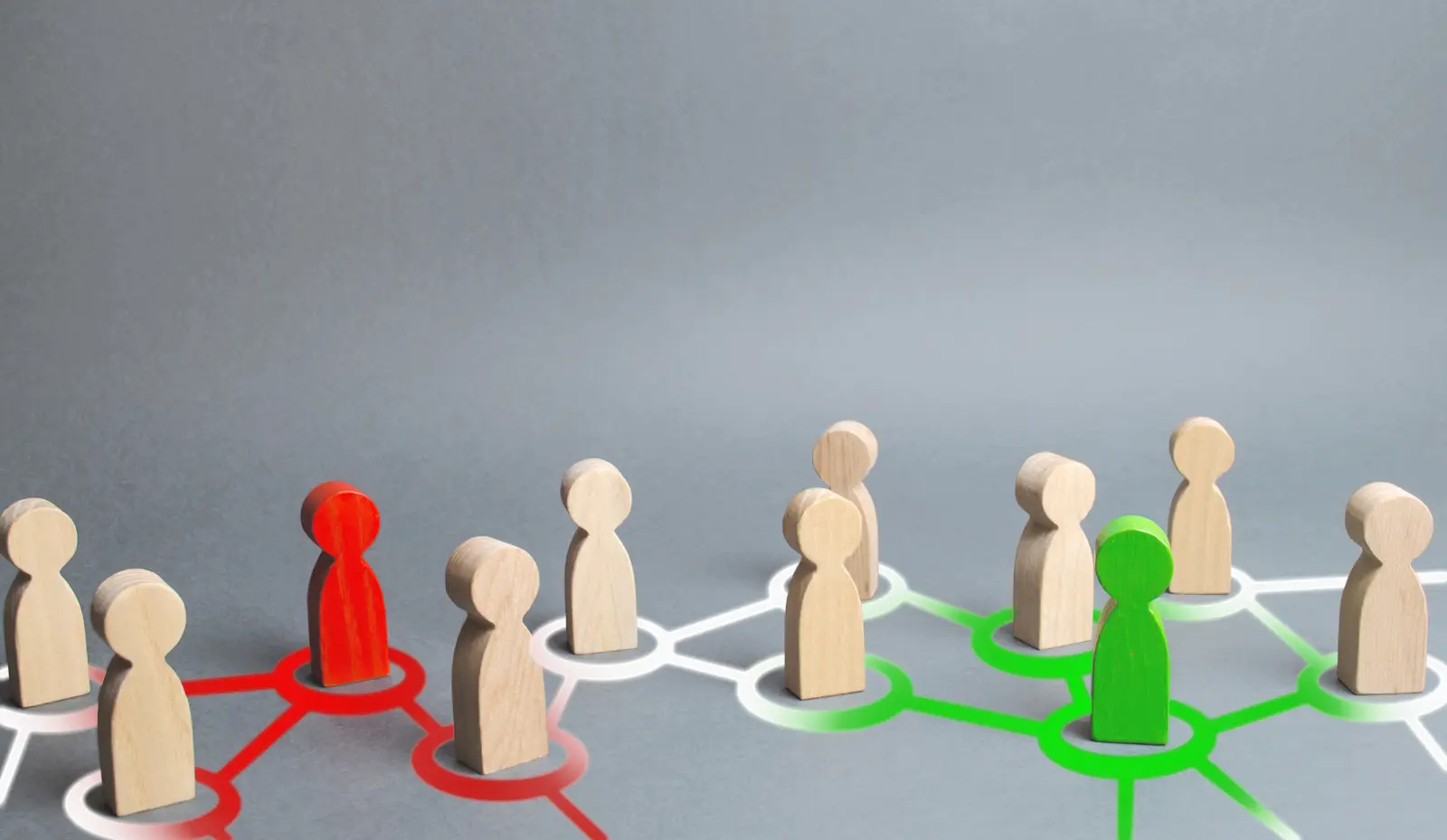
The functioning of any relationship system is dependent on the level of self-differentiation among its members. In this two-part episode, I unpack a schema developed by Daniel V. Papero of the Bowen Center for the Study of the Family.
Show Notes:
Developing a systems model for family assessment. Family Systems: A Journal of Natural Systems Thinking in Psychiatry and the Sciences. 13, 2, 2018 by Daniel V. Papero.
Subscribe to my weekly Two for Tuesday emails.
Become a Patron for as little as $5/month.
[00:00:33.980]
Welcome to Episode 344 of the Non-Anxious Leader podcast. I'm Jack Shetama. If you are new to this podcast, you can connect with me by emailing me at jack@christianleaders.com with your comments, questions, and suggestions for future episodes. You can get more resources at thenonanxiousleader.com, where you can find out about my books, courses, speaking engagements, and coaching practice. You can also subscribe to my Two for Tuesday email newsletter there or at the link that is provided in the show notes. And finally, if you would like to support my work and help make it possible for others to get these resources for free, you can go to the link in the show notes to support me for as little as $5 a month. Thanks in advance for your consideration. And now, without further ado, here is episode 344, Five Ways to Assess the Health of Any Relationship System, Part 2 of 2.
[00:01:36.980]
If you haven't listened to part one of this two-part series, I encourage you to go back and do that first so you can get the first two ways to assess the health of any relationship system. But as a refresher, this series is based on Daniel V. Pappereau's 2018 paper, Developing a Systems Model for Family Assessment. In it, he shares a framework comprised of five different continuums along which one might measure a family system. I then break this down and apply this also to congregations. The first two continuums that were shared last week were resourcefulness and connectedness and integration. Before we get into the other three, I want to focus a bit on leadership through through self-differentiation, which is a term that was coined by Edwin Friedmann. Papparo emphasizes the importance of the family leader, which was also an emphasis of Murray Bowens, the founder of family systems theory. Friedmann took this understanding of leadership in a family and applied it to congregational systems. According to Friedmann, leadership through self-differentiation is a way to describe a leader who can remain a non-anxious presence in response to the inevitable resistance to change that the leader would face.
[00:03:04.060]
He called this resistance, sabotage. Sabotage is typically the unwitting dysfunction that comes when people are uncomfortable with change but are unable to take responsibility for self. Instead of working through their own discomfort, they tend to focus on something else to release their anxiety, creating an emotional triangle. For example, when a congregant is uncomfortable with a new ministry initiative that is reaching out to the surrounding community, instead of taking a healthy stand, expressing their discomfort with a new initiative in differentiated terms, they complain about the number of hours the pastor is spending in the office. Leadership through Self Differentiation recognizes this as sabotage and avoids a conflict of wills with the congregant over their office hours. Instead, they remain a non-anxious presence. That is, they show concern and caring for the congregant without trying to convince the congregant to support the new initiative and without defending themselves against the office hours criticism. In Papparo's paper, he details Bowen's understanding of a family leader which embodies self-differentiation. He characterizes the leader as someone who is motivated to solve problems and get things done, is neither angry nor dogmatic, promotes the well-being of all family members, can manage themselves and avoids instructing others on their behavior, understands what others are thinking and is clear about what represents responsible and irresponsible thinking, and can modify their own functioning in response to the strengths of the group.
[00:04:45.680]
Clearly, Friedmann built his understanding of leadership through self-differentiation on Bowen's thinking. A non-anxious leader knows what they believe and stays connected in healthy ways to all members, especially the most resistant. They are concerned with the well-being of those who engage in sabotage because they know that this has less to do with the leader and more to do with the resister. They also understand that the well-being of the entire system depends on their willingness and ability to stay emotionally connected with the resistors, even as they refuse to coddle them. With that as background, let's get into the remaining three ways to assess the health of any relationship system. Papparo's third continuum for family assessment is tension management, and it has the inability to manage tension on the left side and the ability to recognize and manage tension on the right side. He notes that the terms tension and anxiety appear often together in Bowen's writing, essentially equating them. For example, Bowen wrote that the ability to respond flexibly decreases when anxiety and tension increase in a family and symptoms are more likely to erupt. Papparo also notes that emotional reactiveness, that's his term, or reactivity, that's the way I would understand it, is a prominent marker of tension among individuals and families.
[00:06:17.280]
He emphasizes that managing reactivity involves the ability to recognize anxiety and tension in one's self and in others, as well as the ability to manage and decrease one's own anxiety anxiety. In short, tension management, which is the ability to recognize and manage tension and anxiety, begins with self-regulation. One must first regulate one's own reactivity, which could be attacking, defending, or giving in. It continues with the ability to understand the anxiety and tension in others, understanding that this often has less to do with you and more to do with what's going on in the other. Papparo offers two subcontinent continuums to further describe tension management. The first is unmanaged anxiety versus managed anxiety. Another way to look at this would be the degree to which one can self-regulate their own anxiety. The second continuum continuum is catastrophic thinking versus careful thought and analysis. One might think of this as going from the primitive brain to the neo cortex or thinking brain. In his book, Thinking Fast and Slow, Daniel Kahneman describes two modes of thought. The first is system one, which is fast, instinctive, and emotional. I would call this the primitive brain. The second is system two, which is slower, deliberative, and logical.
[00:07:44.600]
Self Regulation is the first step to getting from system one to system two. It's the first step in getting from catastrophic thinking to careful thought and analysis. Pappereau's fourth continuum has conventional thinking at the left and systems thinking on the right. Conventional thinking focuses on issues, whereas systems thinking focuses on emotional process, or as Edwin Friedmann would say, it's process, not content. Another way to express this, according to Pappereau, is conventional thinking asks, why has this happened? Which leads to subjective interpretation. On the other hand, systems thinking asks, how has this happened and how does it work? This orients one's thinking toward fact and looking at how the system is functioning. One subcontinuum has the idea that change must come from outside the family on the left side, and change must come from in the family on the right. Friedmann would call the left side blame displacement, and it's a function of the lack of taking responsibility for self. Lower functioning families or congregations will blame outside forces for their condition, whereas higher functioning families realize their own response is the only thing they can control. I often work with churches that are aging, and they blame the nondenominational church down the street for taking all the young families.
[00:09:13.980]
This enables them to avoid asking what change would be required on their part to serve and include young families in the life of the congregation. Pappereau also distinguishes between achievement goals and process goals. Achievement goals are what you would think, such as career, financial, or status goals, to name a few. Process goals focus on functioning within the relationship system and can include tension management, self-regulation, reducing cutoff, and detriangling, etc. While Papparo doesn't offer achievement goals and process goals as a subcontinuum, it's clear that a lack of process goals will tend to keep a family or congregation stuck. My view is that process goals are, in essence, the desire to toward greater self-differentiation. Because non-anxious leaders are oriented toward process and not content, they are more likely to lead positive change in systems in which they function. The fifth and final continuum that Papparo offers for the assessment of the health of a relationship system is goal structure. This has no clear goals on the left and clearly, development goals on the right. Self-differentiation includes the ability to know what you believe and where you believe God is leading you. That's self-definition. Without clearly developed goals, an individual can easily succumb to surrounding togetherness pressure, and systems can fall, pray more easily to external forces.
[00:10:47.900]
One subcontinuum that Papperos posits has the absence of achievement goals on the left end and well-formulated achievement goals on the right. Likewise, another subcontinuum has absence of process goals on the left and well-formulated process goals on the right. Is the family working toward raising children to be responsible adults? That would be a focus on achievement goals. Are members of the family working on better defining themselves in healthy ways while staying emotionally connected? Those are process goals. Likewise, one can look at a congregation and ask the same questions. Many declining congregations don't have well-developed achievement goals. They simply say, We need more people and we need more money. Those are not clearly defined goals. My experience is that until there are leaders that focus themselves on process goals, change is unlikely. This is the importance of developing yourself as a non-anxious leader, as well as encouraging others to do the same. It's not easy work, but without it, nothing different will happen. I find these five ways to view a relationship system It would be extremely helpful, despite the fact that Papparo notes that at this point, these are not measurement tools to assess family function as the criteria are hard to quantify.
[00:12:11.260]
Nonetheless, these are lenses through which you can view a family, congregation, or organization. Used in this way, they can be an invaluable way to size up what's going on and how your functioning as a leader can make a difference.
[00:12:29.620]
That's for episode 344. Remember, you can connect with me at jack@christian-leaders.Com and find more resources at thenonanxiousleader.com. If you have found this episode helpful, please leave a review on your platform of choice place, and please share it with somebody who might benefit. Thanks in advance for your help. Until next time. Go be yourself.