
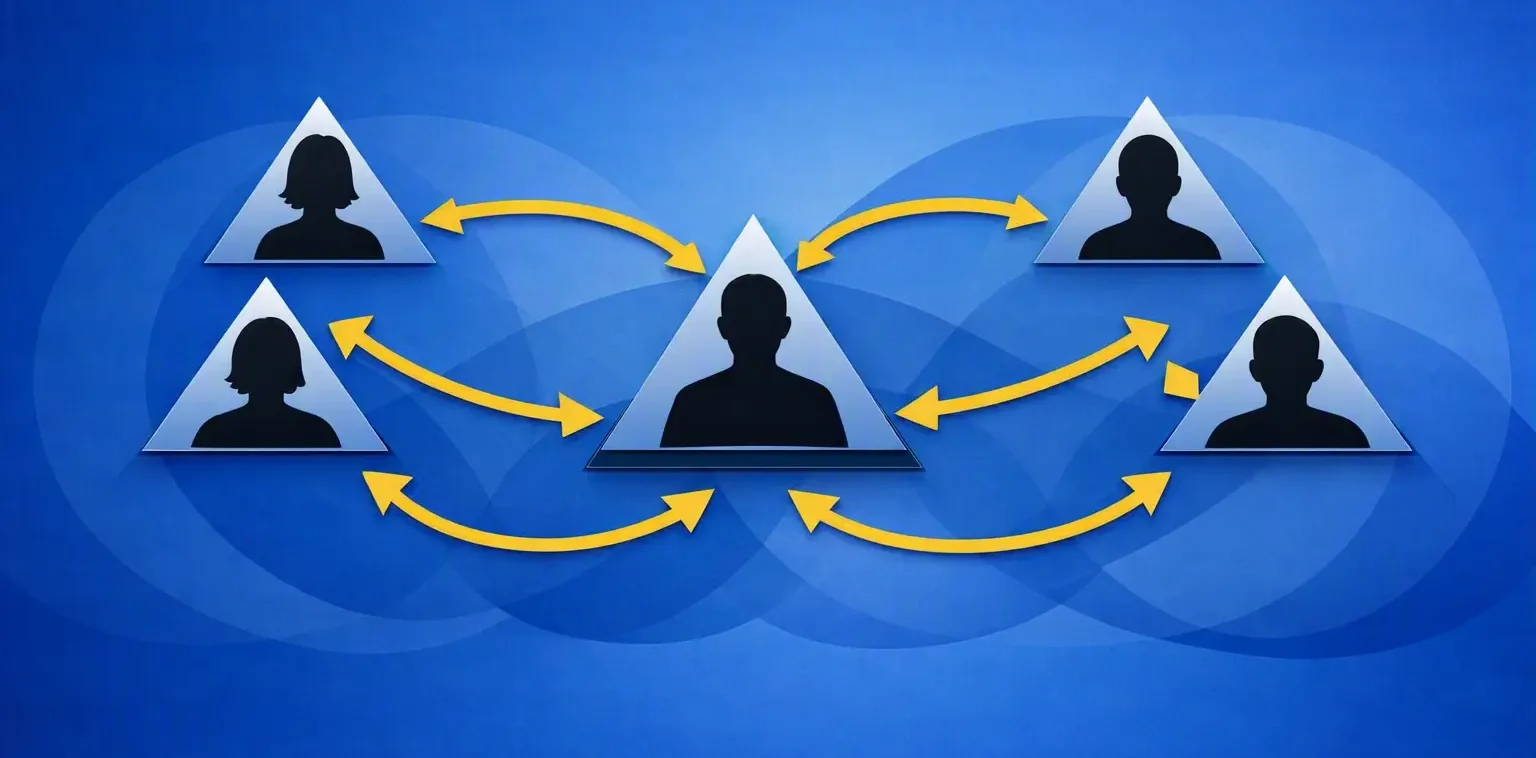
This episode covers how Murray Bowen remained a non-anxious presence in his family of origin, after he had purposely raised the anxiety level of those in the interlocking triangles that were keeping it stuck.
Show Notes:
Family Therapy in Clinical Practice* by Murray Bowen
The Differentiated Leader – The Non-Anxious Leader
Check out The Non-Anxious Life, a FREE AI Family Systems Coach.
Become a Patron for as little as $5/month.
Subscribe to my weekly Two for Tuesday email newsletter.
*This is an affiliate link. I earn a small commission if a purchase is made.
[00:00:34.540]
Welcome to Episode 400 of The Non-Anxious Leader Podcast. I'm Jack Shitama. This is a quick reminder that there is still time to register for the Differentiated Leader, a Family Systems Theory Community of Practice. It will run on the 2nd Monday of each month from 7:00 to 8:30 PM Eastern time. Beginning October 12th. This 8-session program is free and it is a deep dive into Bowen Theory's core concepts. It will apply them through genograms, connect them with mindfulness, positive intelligence, internal family systems, and attachment theory, as well as examine Murray Bowen's and Edwin Friedman's leadership insights. You can sign up at the link in the show notes. And if you are new to this podcast, you can connect with me at jack@christian-leaders.com. with your questions, comments, and suggestions for future episodes. And you can get more resources at thenonanxiousleader.com where you can find out about my coaching practice, speaking engagements, books that I've written, and courses that I offer. You can also subscribe to my Two for Tuesday email newsletter and get your free AI family systems coach at the website or at the links in the show notes. Finally, if you would like to support my work for as little as $5 a month, you can get more information and sign up at the link in the show notes.
[00:01:56.710]
Thanks in advance for your consideration. And a final note, this was intended to be a 2-part series on Murray Bowen's family of origin work, but it was so long it ended up being 3 parts. So without further ado, here is episode 400, How Murray Bowen Reworked His Primary Triangle, part 2 of 3. In the last episode, I shared how Murray Bowen set up his differentiating effort mainly through writing letters to his mother and siblings. If you haven't listened to that episode, please do that first. Since Bowen didn't live near his nuclear family of origin, these letters and a phone call were designed to prepare them for a visit home. Of course, prepare should probably be used in quotes. Bowen was intentionally increasing anxiety and shifting the interlocking triangles so that when he arrived home, he could differentiate with each family member and, hopefully, shift the system toward greater maturity. Bowen's younger sister, the responsible one he called Big Mother, and her husband met Bowen and his wife at the airport. He notes that his wife had no direct knowledge of his efforts at self-differentiation, and that his sister's talking in bits and pieces about all that was going on was the first his wife knew about any of this.
[00:03:22.480]
This highlights a point I made in a previous episode that efforts at self-differentiation will likely fail if anyone else knows about it. He emphasizes that each action and move must come from within the person who is trying to self-differentiate. He also notes that decisions and actions often have to be made instantaneously, that is, in the moment, and regardless of the outcome, one must take responsibility for self. Bowen arrived home late on a Saturday night, and there was no talk about any of the chaos on Sunday morning, other than a brief comment by his mother that she hoped things could work out without any hard feelings. Bowen, his wife, and his parents then went to an early afternoon meal at his younger sister's house. Just as they were finishing dessert, his second brother called to say he had been checking around to see where Bowen was and that he would be over in a few minutes. This was the first major shift. Instead of Bowen pursuing his brother, his brother was now chasing him. Bowen writes, the inclusion of him and his wife made this into the perfect group for this long-anticipated and rehearsed meeting. Every important triangle in the family system was represented.
[00:04:38.150]
I had purposely stayed close to my parents all morning, hoping to facilitate a meeting of most of these people, but good fortune was with me when it worked out this way. My immediate goal was to avoid defending anything or attacking any issues, to be able to avoid getting angry even with provocation, and to have an instant casual response to any comment. Bowen's preparation had come to fruition, and now it was time to see if he could remain a non-anxious presence. Before I move on, let me unpack the important interlocking triangles that were present at this meeting. Of course, there was his primary triangle with his parents. Next were triangles with Bowen, his second brother, and each of their parents. The same would be true with his younger sister, along with a triangle between Bowen and his 2 siblings. Another important triangle was Bowen, his second brother, and his brother's wife, whose own brother had died. This raises an important point. To the extent you can be with the people who belong to the interlocking triangles you are trying to rework, You will have a better chance. This is why life cycle ceremonies such as funerals, weddings, births, retirements, etc., are great opportunities to do this work.
[00:05:56.860]
Not only will more of the major players be there, but anxiety is likely to be higher, meaning old patterns of functioning are likely to emerge. This gives you the chance to function as a non-anxious presence in response to those patterns. In Bowen's case, he had to manufacture a situation, which he did with his letter writing. Even though the anxiety of the system was initially boosted by the sudden death of his sister-in-law's brother, he knew that this wouldn't be enough to keep anxiety levels up at the time of his visit. This is why Bowen's approach is so next level. He purposely increased the anxiety in the system by refusing to follow his role and old patterns. Then he prepared and rehearsed his responses to what he knew would be the inevitable pushback, that is, sabotage. So back to the story. When Bowen's second brother arrived at their sister's house, he exchanged brief pleasantries, took out the letter, and said he wanted to discuss it and that Bowen had clearly written it when he was drunk. Here's Bowen's first paradoxical and playful response: I said that was an advantage in living where booze was cheap and that if his supply was low, I could get some good prices for Note the elements here.
[00:07:13.890]
He doesn't argue and doesn't agree. He's playful. Edwin Friedman said that the primary function of paradox was not to come up with zingers but to regulate your own anxiety. In doing so, you're able to avoid a conflict of wills. Contrast Bowen's response to what a typical response would be, something like, I wasn't drunk. I meant what I said and you needed to hear it. This is arguing content and is a surefire way to keep things stuck. I'm now going to read a long quote from Family Therapy in Clinical Practice because I think it's important to hear Bowen's own words about how things transpired. The meeting went on for 2 hours and was all personal. The principals in the center were my brother, his wife, and me. My wife and my father were slightly out of the group. My mother moved around just back of the main group. Most of the conversation was between my brother and me and mother, with a few comments from my brother's wife. My brother had reacted most severely to a story about him and threatened a libel suit against me. I agreed that it was awful to start such stories, and I thought he should find out who started that story and prosecute the person to the full extent of the law.
[00:08:29.300]
There was more talk about stories, and I expressed surprise he did not know what others said about him. I hoped he would pay more attention to the stories in the future, since he lived there all the time and I only heard them when I visited. His wife had reacted most to the story about their son, to which he said, I always say nice things about your children. I responded, I have heard nice stories about all of you, too. There was just not time to remember all of them. Then my brother and his wife began to report negative stories about me, to which I responded with some version of, That was a fairly amusing one, but there have been some really good ones about me if you had just paid attention and listened better. Mother was pacing back and forth in the back with comments such as, I hope I do not die and leave a divided family. At one point toward the end of the meeting, my brother accused me of being in league with Mother and that the whole thing started when she and I took that trip together to see the lands of her ancestors.
[00:09:27.100]
You really are intuitive about some things. How did you know about that? You're right, that's when she and I planned the whole thing. Mother responded vigorously with, That's the biggest lie I've ever heard! I will never tell you anything else again! I turned to my brother and said, Now you see how she tries to wrangle out of things when she is caught with the truth. At the end of the meeting, as my brother and his wife were leaving, his wife said, I never saw such a family in all my life. I think we should do more talking to each other and less talking about each other. End quote. Bowen said that afternoon was one of the most satisfying times in his entire life. He makes several points, and I want to highlight 4 of them. First, he had participated in the most intense family emotions possible while staying out of its quote-unquote ego mass. That is, he was able to be a self when everyone else was being defined by surrounding togetherness pressure and the triangles they were in. In doing this, he avoided getting fused into the system by avoiding reactivity and adaptivity. Second, he had avoided being triangled.
[00:10:36.480]
For example, when his brother accuses him of cooking this whole thing up with their mom, he feigns surprise that his brother discovered their conspiracy. He used playfulness and paradox to avoid being triangled by his brother and mother. It worked so well that his mother said she'd never tell him anything again.
[00:10:53.550]
That's progress.
[00:10:55.780]
Third, about 2/3 of the way through the meeting, he noted that the family system had lost its emotional punch— that is, the anxiety level had decreased. At that point, he knew that he had a good chance of getting through the meeting without getting triangled or caught in a conflict of wills. The important point is that when one can remain a non-anxious presence, it gets harder for others to maintain their emotional intensity. This is the beginning of finding a new way for the system to function. For example, when his sister-in-law says they should talk more to each other than about each other, that's already a step towards maturity. And fourth and finally, this was when he knew the approach working out a self in one's family of origin was the key to self-differentiation. He notes that he had spent a dozen years thinking about the structure and function of what he called this quote-unquote undifferentiated family ego mass. During this time he only experienced partial successes in differentiating, which moved the system very little, so he was hardly prepared for the success he experienced in this visit. To him, the most important finding was that an emotional system has a knowable structure and function and that one can work out predictable answers to problems on a drawing board.
[00:12:16.760]
Bowen had finally experienced what he had only theorized, that a person who can remain a non-anxious presence in the middle of intense family emotion can shift the entire system. But the work wasn't finished. He still had to stay connected, especially with the most reactive members of the family. We will cover that in the next episode. That's it for episode 400. Remember, you can connect with me at jack@christian-leaders.com and find more resources at thenonanxiousleader.com. And if you found this episode helpful, please share it with someone who would benefit, and please leave a review on your podcast platform of choice. Thanks in advance for your help. Until next time, go be yourself. Thank you for listening.