
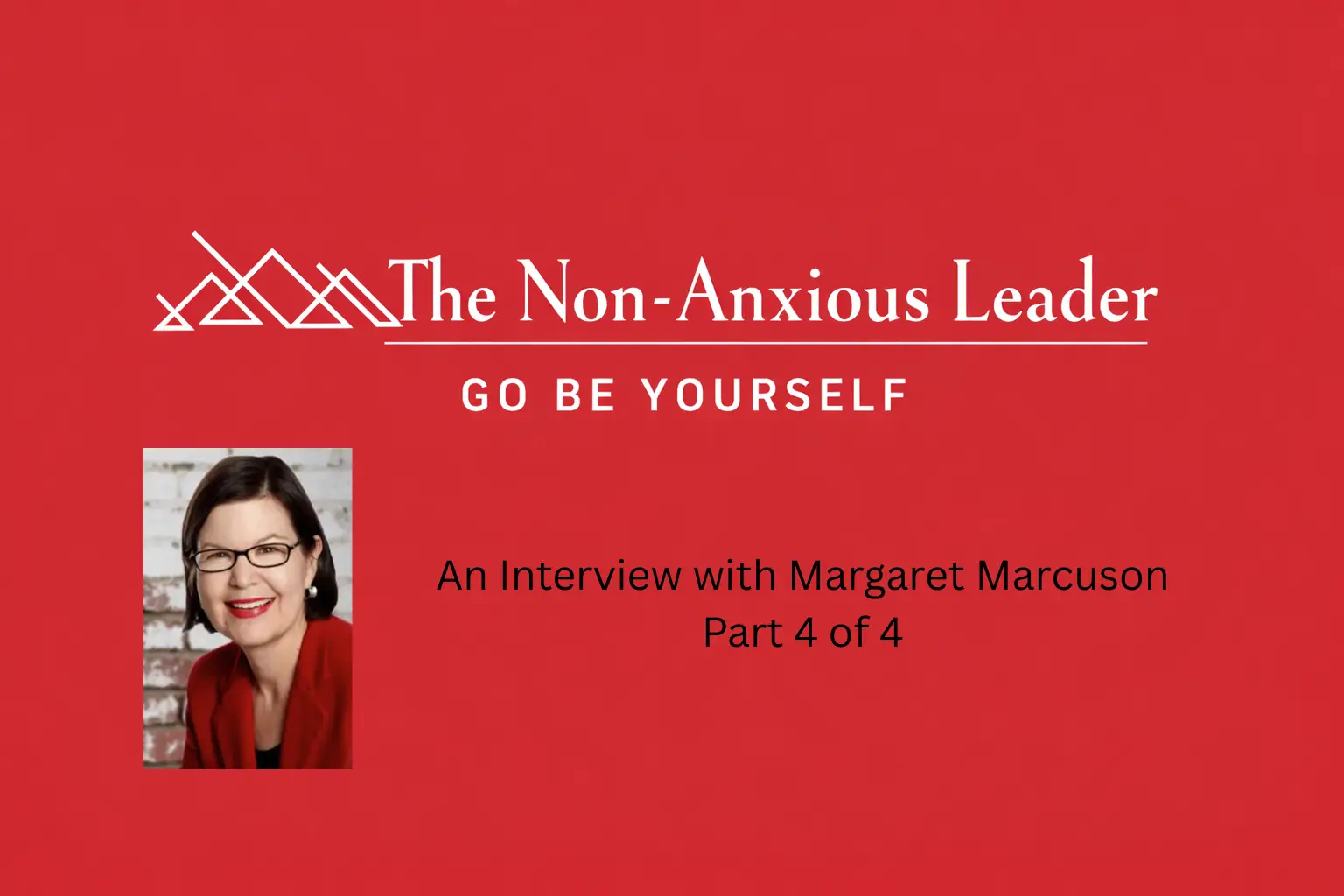
Margaret Marcuson is an ordained minister, author, coach and longtime family practitioner. In this episode she discusses how to manage triangles and why productivity is overrated.
Show Notes:
Sustainable Ministry: How to Lead (and When to Nap)* by Margaret J. Marcuson
Leaders Who Last: Sustaining Yourself and Your Ministry* by Margaret J. Marcuson
Money and Your Ministry: Balance the Books While Keeping Your Balance* by Margaret J. Marcuson
Check out The Non-Anxious Life, a FREE AI Family Systems Coach.
Become a Patron for as little as $5/month.
Subscribe to my weekly Two for Tuesday email newsletter.
*These are affiliate links. I earn a small commission if you make a purchase.
[00:00:01.440]
Welcome to Episode 390 of The Non-Anxious Leader podcast. I'm Jack Shitama. If you are new to this podcast, you can connect with me at jack@christian-leaders.com with your questions, comments, and suggestions for future episodes. And you can get more resources at thenonanxiousleader.com where you can find out about my coaching practice, speaking engagements, books that I've written, and courses that I offer. You can also subscribe to my Two for Tuesday email newsletter and get your free AI family systems coach at the website or at the links in the show notes. Finally, if you'd like to support my work for as little as $5 a month, you can get more information and sign up at the link in the show notes. Thanks in advance for your consideration. And now without further ado, here is episode 390, an interview with Margaret Markison, part 4. Hi, Markison.
[00:01:29.430]
Of Four. In your book, you spend some time on triangles, which is a really important concept in family systems theory. What's your advice for managing triangles since they're everywhere?
[00:01:46.290]
They're everywhere. Well, I want to say the triangles are not bad in and of themselves. There's a, there's a certain amount of rhetoric that I said, I'm going to get out of that triangle. Well, you're in it. If you have this position, you're in the, you're in a triangle with the lay leader and the treasurer, for example. Mm-hmm. So how do you manage yourself in those triangles? And the basic rule is you work on the relationships that you are a part of, and you don't take responsibility for relationships you are not a part of. So in that triangle, the lay leader and the treasurer, they have their own relationship. You're not in that relationship. So you stay connected to the lay leader. You stay connected to the treasure or whatever the triangle is. And you work on talk— if the lay leader wants to talk to you about the treasure, you work on talking less about the other person in that triangle and asking them about themselves and what they think.
[00:02:46.990]
Because when you do talk about the other person, you're bringing them into the relationship instead of it just being the two of you.
[00:02:54.920]
Yeah, yeah. It's way easier said than done. Right.
[00:02:59.380]
Yeah, so to that point, if the treasurer wants to talk about the lay leader, how do you not do that?
[00:03:08.060]
Well, you can ask them about themselves in that relationship. You could start there and say, you know, tell me more about what happens in, you know, how do you feel when they do that? And you could coach them a little bit on how they might respond a little bit differently. So the one other thing I wanna say about these triangles is that there are times to triangle in someone else. So if you have a church member who's harassing you, that's not your problem alone. This is a church problem.
[00:03:45.810]
Mm-hmm.
[00:03:46.110]
So you can say to some, another key leader, I just want you to know that, you know, Fred is calling me at 10 o'clock every night and leaving angry voicemails, and I need your help.
[00:04:03.100]
Explain that. Explain, because most people would say, oh, well, that's, you need to deal with that yourself. Explain where the value is in that and how that helps.
[00:04:12.020]
Yeah. It spreads the responsibility around. So, and you do it in a thoughtful way. You think of through a strategy, maybe you do get some coaching. I I have this church member who is persistently harassing me. And you create a strategy for yourself where you're not just complaining about Fred. You are asking someone to share the responsibility for the collective life of the church.
[00:04:42.340]
Yeah, I think that's what sharing the anxiety, right?
[00:04:48.060]
Yes, right. You're spreading the anxiety around. You're not holding onto it. And you can do this about finances too. I think church sometimes, financial leaders keep any money problems close to the chest. And you could try and call in the congregation and say, you know, in partnership with them, but to make it, share the anxiety. I had a colleague, Michael Nell, who would say, so anxiety's like manure. If you leave it in one place, it clogs everything up. If you spread it around, it fertilizes.
[00:05:26.300]
That's great. Okay. So, so in that case, you're using triangles to help spread the anxiety. Never thought of it in that way. That's helpful. So you talked about money and, and you wrote a whole book about it. What is the relationship between money, anxiety, and leadership and ministry?
[00:05:49.540]
Well, money is a natural focus for anxiety. I think that's because, at least in our society, it's about survival. You gotta have money to survive. So some of those primal instincts kick in when we're dealing with money.
[00:06:06.540]
What does the leader do about that when people are so focused on money?
[00:06:12.000]
Well, you don't try to calm them down. I'll put it that way, 'cause they'll be able to one-up you every time on that. So I think several things you can do. One is to think about your own family origin and money and what was the story and what might be your own trigger points. And that was very useful for me. It was one of the areas early in my ministry I was the most anxious about. My dad was anxious about money until he couldn't be anxious about it anymore. So that was my heritage. And to get thoughtful and think of it, like this is something you can't avoid. As a pastor, this is part of your responsibility and you wanna be in on these conversations. And to get— that helped me to get clear about my own role. I'm on the lifetime plan in relation to money and anxiety still to this day. But clarifying my own role and seeing that it was important for me to share leadership with congregational leaders on this, that matter, that helped me. a great deal and getting more skill, seeking that out, getting some training.
[00:07:26.500]
So getting skill in managing money.
[00:07:28.320]
In managing money, yes, yes. You know, some pastors have a business background and they bring a lot of expertise already, but a lot of pastors really don't understand the technique of stewardship or how to read a balance sheet, a financial report. And there's a great book by the Jamisons on— is that book called? Philip and Janet Jamison. It has a lot on just how to read the financial statements. Ministry and Money.
[00:08:04.360]
That's the name of the book.
[00:08:05.540]
Ministry and Money.
[00:08:05.560]
Ministry and Money. Yeah.
[00:08:07.820]
I'll put links to Margaret's other books in the In the show notes too. So if you wanna look those up even before the new one comes out, you can do that. That's to the listeners. You write in the new book that productivity is overrated. How'd you learn that, that productivity is overrated?
[00:08:27.390]
Well, productivity as a thing in itself is overrated. It's got, what is the productivity for? Okay. And it gets back to what I was saying about administration, that you're not just trying to get things done to get things done, to get through all your emails. You have an empty email inbox. But what's your purpose?
[00:08:49.210]
And so when you're trying to focus on doing important work, productivity matters. But if it's applied to something that's maybe less important, it doesn't matter?
[00:09:02.730]
Is that what you're saying? Well, that's a good— I guess I wouldn't put it quite that far. There are things that just have to get done at church. It may not be your highest priority, but if you need to get the information for the bulletin, you gotta get that in.
[00:09:17.010]
Yeah.
[00:09:17.230]
So how do you determine like when productivity is helpful and when it's not?
[00:09:23.710]
If productivity keeps you from being present with people, it can get in the way of relationships.
[00:09:30.530]
Okay.
[00:09:32.110]
If it helps you carry out your mission and calling, and make time for people, it's helpful.
[00:09:41.080]
That's great. Yeah, because presumably in the, in that latter case, because you're more productive, it doesn't take you as long to do the work you need to do and you then have time with people.
[00:09:52.460]
Yeah, that's right. Including your family.
[00:09:54.660]
Right.
[00:09:55.340]
And the people that you care about. I always say set an ending time for your day. Work expands to fill the time allotted and you could work all the time. The work is never done. So you have to make choices about when you're gonna stop. I was talking to somebody in the pandemic and said, "So could you set an end time for your day?" And he said, "Yeah, I could stop at 11:00 PM." Okay. Okay, great. You do that. Better than nothing.
[00:10:26.240]
Right. To start.
[00:10:27.920]
Yeah, to start, yes.
[00:10:30.260]
Well, and then the other part of that is then being able to communicate that to others so that you're setting a boundary for yourself, right? Yes. For your own care, well-being.
[00:10:42.800]
Yeah. When will you respond to texts or voicemail or email? When will you take a break? You can take a break.
[00:10:51.960]
Yes, you should take breaks.
[00:10:53.660]
You should take breaks.
[00:10:55.680]
It's actually more productive. It is.
[00:10:57.420]
Well, this is, I think, pretty much documented in the research that if you take breaks, you are more productive.
[00:11:03.280]
Right.
[00:11:03.440]
You have a hobby.
[00:11:05.430]
You write, "Letting go is a spiritual practice." Unpack that for me. Letting go is a spiritual practice. What do you mean by that?
[00:11:14.270]
Well, the ability, the work of letting go involves trust in God, trust that you are not responsible for everything and that you can let things work themselves out. And that God is at work, even if it doesn't all go perfectly, it's not all up to you.
[00:11:34.340]
That's hard.
[00:11:35.300]
It's really hard. It is hard, but there's a lot of freedom to the degree that you can let go. There's more freedom and you are trusting other people to God.
[00:11:47.820]
Which is, I guess, when you're talking about being sustainable in whatever you're doing, that's That's the point of that, of being able to let go of things.
[00:11:57.360]
Yeah, yeah, that's right. And it's paradoxical. So if you can let go, you may be able to have more influence than if you are constantly gripping onto control of everything and everybody. Applies to church and family, maybe the world at large.
[00:12:16.020]
Yes, great advice. Well, we're gonna end with that advice, but before we do, where can people find you? Where would you direct them if they wanna find out more about you?
[00:12:26.560]
So my website is margaretmarcuson.com, and you can get all my books on Amazon and Bookshop.
[00:12:36.780]
I'll put a link to Margaret's website in the show notes. Look her up and check her out. Thank you, Margaret, for taking the time to be here with me, and blessings to you and your work, and look forward to crossing paths again.
[00:12:51.170]
Likewise. Thanks so much, Jack.
[00:12:53.690]
That's it for episode 390. Remember, you can connect with me at jack@christian-leaders.com, and you can find more resources at thenonanxiousleader.com. And if you found this episode helpful, please share it with someone who would benefit, and please leave a review on your podcast platform of choice.
[00:13:12.710]
Thanks in advance for your help. Until next time, go be yourself.