
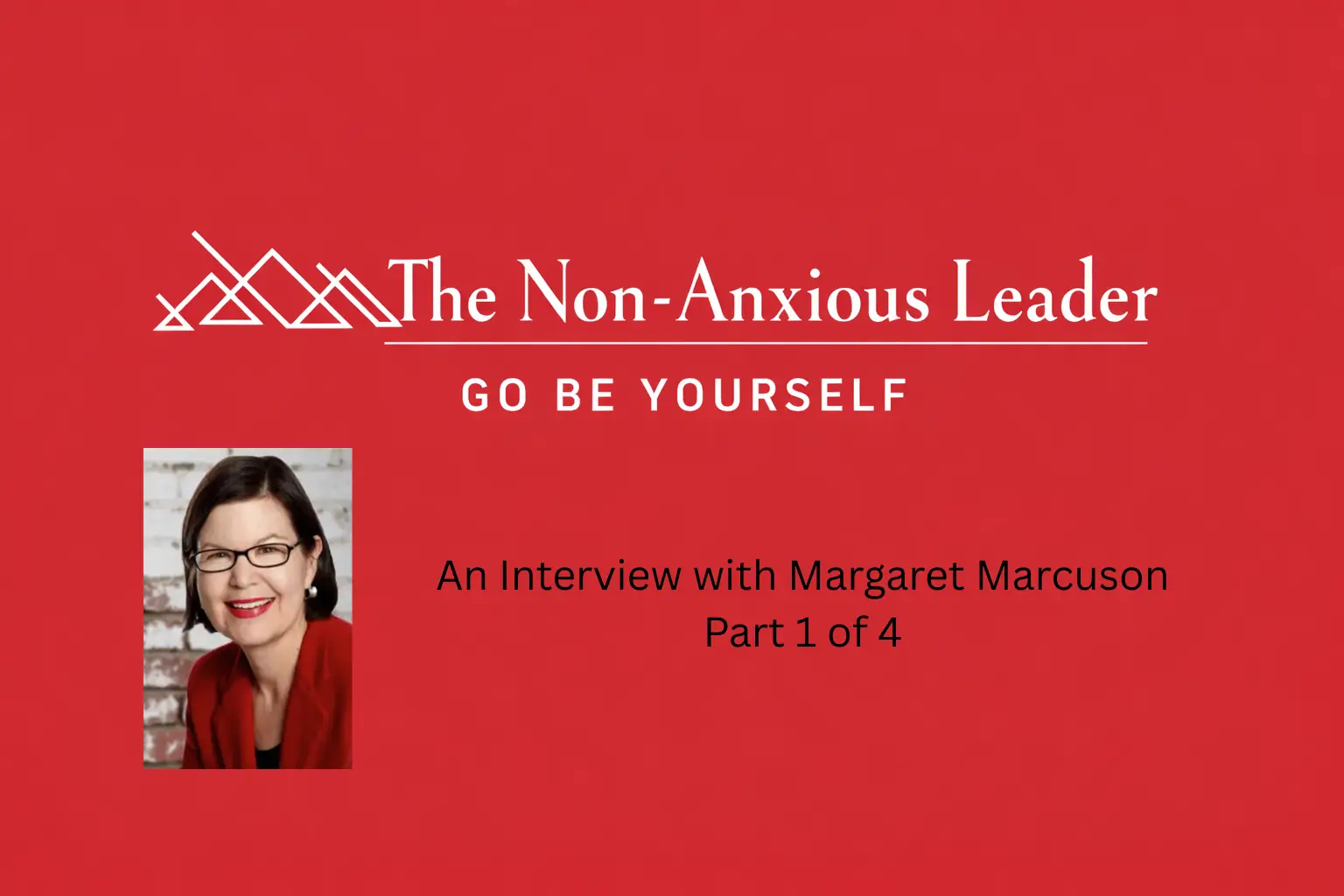
Margaret Marcuson is an ordained minister, author, coach and longtime family practitioner. In this episode she shares how she first got into family systems theory and what she learned when studying with Edwin Friedman.
Show Notes:
Sustainable Ministry: How to Lead (and When to Nap)* by Margaret J. Marcuson
Leaders Who Last: Sustaining Yourself and Your Ministry* by Margaret J. Marcuson
Money and Your Ministry: Balance the Books While Keeping Your Balance* by Margaret J. Marcuson
Check out The Non-Anxious Life, a FREE AI Family Systems Coach.
Become a Patron for as little as $5/month.
Subscribe to my weekly Two for Tuesday email newsletter.*These are affiliate links. I earn a small commission if you make a purchase.
[00:00:00.100]
Welcome to Episode 387 of The Non-Anxious Leader Podcast. I'm Jack Shitama. If you are new to this podcast, you can connect with me at jack@christian-leaders.com with your questions, comments, and suggestions for future episodes. And you can get more resources at thenonanxiousleader.com, where you can find out about my coaching practice, books that I've written, speaking engagements, and courses that I offer. You can also subscribe to my Two for Tuesday email newsletter and get your free AI family systems coach at the website or at the links in the show notes. Finally, if you'd like to support my work for as little as $5 a month, you can get more information and sign up at the link in the show notes. And one of the bonuses for being a supporter is you will have access to the entire YouTube video of my interview with Margaret Markison.
[00:01:29.250]
Thanks in advance for your consideration. And now, without further ado, here is Episode 387, An Interview with Margaret Markison, Part 1 of 4. My guest today is Margaret Markison, and she helps clergy get lighter and less burdened by their ministry so they can have more influence with less stress. She works with leaders from over 20 denominations across North America as a teacher and a coach. She's the author of Leaders Who Last and Money and Your Ministry, and her new book, Sustainable Ministry: How to Lead and When to Nap, comes out on July 9th. Margaret has taught since 1999 in Leadership in Ministry, a family systems workshop for clergy. She's an American Baptist minister and served as pastor at First Baptist Church, Gardner, Massachusetts for 13 years. She lives in Portland, Oregon, where she sings in two choirs. Margaret, welcome to the Non-Anxious Leader podcast.
[00:02:33.310]
Thanks, Jack. It's great to be here.
[00:02:35.270]
Great to have you. I'm excited. I've, I've heard your name before, uh, in the family systems circles, and I'm glad that our common friend, uh, introduced us. So how did you learn about family systems theory?
[00:02:48.110]
In the early '90s, I came across a book at the public library. It was The Dance of Anger by Harriet Lerner. So that was my very first introduction and it literally changed my life. I was angry about some family issues that were going on and reading that book helped me realize, oh, it was, I played a part in this and there were things I could do to change my functioning.
[00:03:15.440]
So what was your next step after that? How did you, how did you kind of dig deeper into family systems theory?
[00:03:21.500]
I remembered that there was this rabbi, Edwin Friedman, who didn't— I thought, didn't he write something about this? And I read his book, Generation to Generation. And I thought, oh, there's more here. And then a friend of mine sent me a letter of invitation to Friedman's training program for clergy. So I went to that program and that changed my life again. Wow.
[00:03:45.040]
So that was the Center for Family Process in Washington, D.C.?
[00:03:48.180]
Yeah, it was his program that he started that evolved into Center for Family Process. Yeah.
[00:03:52.440]
Yeah, yeah. Were you serving in pastoral ministry at the time?
[00:03:56.280]
I was, yes. I was in Gardner, Massachusetts, a smallish Baptist church in central Massachusetts. And I went with a close friend, the friend who sent me the letter, and we still talk all these years later. We still talk about matters and sort of coach each other about family and ministry issues.
[00:04:15.300]
So at the time, how did family systems theory help you in terms of your leadership and the pastoral role or even personally? In your family?
[00:04:28.040]
Well, in terms of pastoral ministry, well, I'll just tell you one line from that letter that he sent out, an invitation. He said, "Stress comes less from overwork than from taking responsibility for the problems of others." And I thought, I want to know more about that. Because I was stressed. I was a little bit burned out. And I, I knew that I couldn't keep doing it the way I was doing it.
[00:04:55.500]
And that, that letter was from Edwin Friedman?
[00:04:58.140]
It was, yeah, it was, it was his letter. So she had somehow— my friend had gotten this letter, uh, she got on his list and so she got the letter and she said, oh, you want to go to this? So we did. Yeah.
[00:05:08.000]
And have you done any, uh, studies like on Bowen? Like the— I mean, because a lot of people say Bowen family systems theory and they don't even talk about Edwin Friedman.
[00:05:17.500]
Yeah.
[00:05:17.840]
Um, so what What encounters have you had with Bowen's work?
[00:05:21.760]
So I've read his book and I've watched a lot of videos with Bowen and read some of the Michael Kerr books about Bowen theory. And I do think it's useful to be well-grounded in kind of the origin story of Friedman's work. So I draw on both streams in my own work.
[00:05:43.960]
What guidance would you give to someone who is new to family systems theory?
[00:05:48.230]
Well, if someone is brand new, I really like the books of Kathleen Smith, Everything Isn't Terrible and True to You. She's very clear, well-grounded in theory, practical. And I've used them with my own clergy group, some of them with people who've been doing this stuff a long time, and they have found them helpful as well. I think it's great for beginners as well. And you can always just start by being curious. Stepping back and let's look at what's going on around you. And what was the big eye-opener for me is looking at your part in whatever is going on, begin to be reflective about how you're relating to others and what you think.
[00:06:35.450]
Yeah, you mentioned when you were in pastoral ministry that you were taking responsibility for others. Tell me about that. How did you break free of that?
[00:06:45.840]
Well, so the classic story about me taking responsibility was, and I told the story in Leaders Who Last, I was standing in the back of the church on Easter Sunday morning and waiting for the processional to begin. And someone tapped me on the shoulder. It was a member of the executive board. And he said, you know, I think we're gonna have to do something about that cracked toilet. And it just threw me into a tailspin. Like, here I'm trying, we're trying to do ministry here. And he's asking me about the cracked toilet on Easter Sunday. That's when I really felt the burden. Like, I have got to do something different here. This is not working for me. Well, later I began, I realized we need people around who care about the cracked toilets. It's actually a gift. And, but, but the, the, over time, I think what I realized is I I couldn't— this church had been in existence since 1830. It was not up to me to make sure that they carried on another 100-plus years. I just had to bring my own gifts, my own sense of what God might be up to with me and with us together.
[00:08:03.490]
It just helped me lighten up about the whole process. And it was a lot more fun after that.
[00:08:10.110]
That's, that's so it, it, it worked. It helped you to, uh, bring your best self. It helped you to, uh, enjoy ministry more. Tell me about your transition from, I guess you went from there to teaching and coaching.
[00:08:22.080]
Is that correct? Yeah. So that was a long process. I, I, I actually, so we were from originally from the West Coast and we moved to Massachusetts for me to serve this church. And I really didn't want to live 3,000 miles from my parents until they died. And I was ready for something new. And I originally moved back west thinking I would do a new church start. And the Leadership and Ministry Workshop had just started going. I think this was its third year. And someone said to me, "I think you're called to start a new church. I think you're called to help clergy and churches be healthier." And that felt like a word from the Lord.
[00:09:03.680]
Excellent. And can you explain to people, to the listeners, what Leadership in Ministry is, the program itself?
[00:09:09.520]
Yes, it's a family systems training program for clergy that was started by Larry Matthews, who was a student of Edwin Friedman's and then taught in his program as well. It started in maybe the early '90s, still going on now under the auspices of Columbia Theological Seminary. So people just keep coming back and back because they find that the work keeps going and it helps them maintain themselves in ministry over many years.
[00:09:41.180]
And when you say they keep coming back and back, is it, are there specific programs or how does, what's the structure of Leadership in Ministry?
[00:09:49.260]
It is, it's really the same thing every year. So there are presentations about theory and ministry. There is, there's small group coaching and sometimes people do engage in individual coaching as well. So it's, it's twice a year.
[00:10:06.540]
It's interesting though. You say people come back and back because the people I, I talk to that are immersed in this have been for many years and it is a life's work, right? You, you're just trying to get a little bit better, a little bit better.
[00:10:22.960]
And this is what I say to my own clients and coaching or in groups. I'm on the lifetime plan. This is, this is it's the work of a lifetime to figure out who you are, what you want, how to relate to others. And there's always more to learn.
[00:10:39.180]
And I think the mistake I see some people make is they'll encounter this material and they'll understand it and they think, oh, well, that's it. I'll move on to something else. But taking it from understanding it to actually applying it in real life is a huge leap, I think. How else could somebody do it besides having a coach or having a cohort to work in. Have you seen people do it otherwise?
[00:11:09.040]
Well, I mean, that's how I started. I just took the books and I thought, worked on my, I'd started to create a family diagram. I think I would've made more progress if I'd had a coach at the time. But I really feel like I was able to take Harriet Lerner's work and think through some things and make some changes that led me into more longer-term study with it, with, uh, in a, in a program with a coach. Yeah. I, I think it, it's really the best way to do it.
[00:11:36.950]
So you, you had enough initiative to do your own work?
[00:11:41.330]
Well, pain, pain is a great motivator.
[00:11:43.330]
I think, uh, the way I heard Friedman say it is fed up is a gift.
[00:11:47.590]
Yeah. Fed up is a gift. Yeah. No, no, nothing. He said nothing can change in a family until somebody gets fed up.
[00:11:54.030]
What was it like to work with Edwin Friedman?
[00:11:57.050]
Well, he was definitely a force of nature, a brilliant, fertile mind. He was lecturing to us from his chapters in what became the book Failure of Nerve, which is a book I highly recommend, more relevant than ever. I'm using it with one of my groups right now. So it just made you think. And I still have phrases like the one from the letter that are in my head. And I was thinking also about a time when he would just do coaching in a large group. And so he coached me about a staff member who was running rings around me. And he said, "Who's gonna teach you how to be mean?" And I said, "Oh, it's not possible." And he said, "Oh, you can do it in a nice way." And in some way he subtly implied that I wasn't quite up to it, which I realized much, much later was a strategy to challenge. It was a challenge, which I took up. I thought, "By gosh, I'm going to do this." And all I did was not protect that individual and they quit immediately.
[00:13:16.000]
So you, you learned how to be mean in a nice way.
[00:13:18.680]
Mean in a nice way. Mean in a way that worked, that worked for me. Coming from a very, very nice family where we don't like to, to talk about difficult things.
[00:13:26.660]
So I had a, I have a friend who's, whose family was, uh, actually worked with Friedman and they thought he was arrogant. And, and I've read the same thing about Bowen. I, and I guess maybe there's something about when you're that direct with people, they don't, they don't like it. And maybe it's mean, right? Yeah. Maybe it comes off as mean.
[00:13:47.110]
Yeah. Yeah. It was interesting. I, I, I, one of the videos of Bowen that I watched was him working with a family that had a schizophrenic daughter. And it was a group of maybe there were 6 around the table and he was working with the oldest daughter who he thought had the most potential. But at one point, the, the identified patient the daughter started just talking gobbledygook and he said to her, you can do better than that. And she started making more sense instantly.
[00:14:19.380]
Wow.
[00:14:19.560]
I have never forgotten that about the power of challenge for people at any level.
[00:14:24.680]
Yeah, that's, that's incredible. Um, that makes me kind of want to follow two paths here. One is how would you suggest people learn how to challenge others in a, in a healthy way, in a nice way? What have you learned that can be helpful to people?
[00:14:40.790]
I think it, there's a lot to be said for defining yourself and saying, here's how I see it. And there was another video with Bowen where he was saying, he said, he suggested not saying you as a way of coming around. This thing needs to change, that kind of approach. Uh, and I think this is where number one, having a coach or a coaching group can be helpful where you bring something and to, uh, to have someone who can help you think through what's the best way to take a stand here. And over time you can look at your own family story and what it, where are the gifts and the challenges in that bringing clarity to these difficult situations.
[00:15:30.060]
That's it for episode 387. Remember that if you support my work as a patron, you get access to the entire YouTube video of this interview. You can find more information in the show notes. And remember, you can connect with me at jack@christian-leaders.com, and you can get more resources at thenonanxiousleader.com. And if you found this episode helpful, please share it with someone who would benefit, and please leave a review on your podcast platform of choice. Thanks in advance for your help. Until next time, go be yourself.